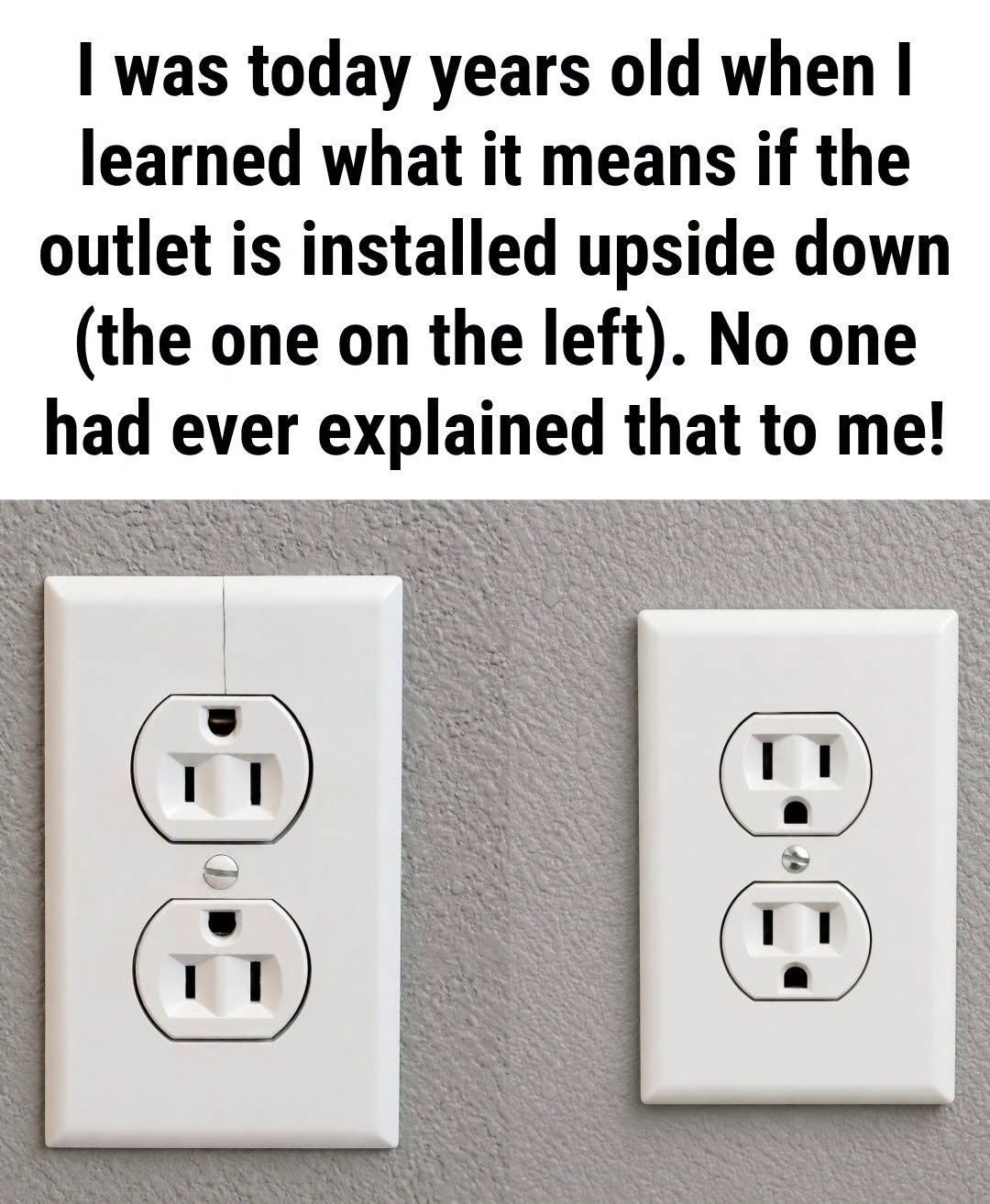
Have you ever walked into a room and noticed that one electrical outlet appears to be installed upside down?
At first glance, it may look like an installation mistake. After all, most residential wall outlets are installed with the grounding hole facing downward, so seeing one positioned the opposite way can immediately catch your attention.
But an upside-down outlet isn’t necessarily a mistake.
In many homes, an inverted receptacle can serve as a visual clue that the outlet is controlled by a nearby wall switch. This setup is especially common in bedrooms, living rooms, dens, and older homes where a room may not have originally included a ceiling light.
However, there’s an important detail to remember: an upside-down outlet does not automatically mean it is controlled by a switch.
Outlet orientation can vary according to local practices, electrician preference, the age of the home, or previous electrical work.
So what does that unusual orientation actually mean?
What Does an Upside-Down Outlet Usually Mean?
An electrical outlet installed with the grounding opening at the top may indicate that the receptacle is switch-controlled.
This type of setup was commonly used in rooms where a ceiling-mounted light fixture wasn’t installed. Instead of adding overhead lighting, an electrician could wire a wall switch to control a receptacle where a homeowner could plug in a table lamp or floor lamp.
With this arrangement, turning on the wall switch can provide room lighting without requiring a ceiling fixture.
In many installations, only one half of a duplex receptacle is switched.
That means one plug remains energized continuously, while the other is connected to the wall switch.
For example, you might plug a lamp into the switched portion and connect a clock or another device that needs continuous power to the always-on portion.
This arrangement can be particularly convenient because a single wall switch can effectively control a lamp without requiring additional wiring.
Why Would an Electrician Flip the Outlet?
The upside-down orientation can act as a quick visual indicator.
Imagine entering a room with several outlets. If one receptacle is installed in the opposite orientation from the others, an electrician or homeowner may immediately recognize that something about that outlet’s wiring could be different.
In some homes, this convention is used specifically to identify a switched receptacle.
However, it is not a universal rule.
An electrician may install every receptacle in the same orientation, regardless of whether it is switched. Another electrician may use an inverted orientation as a helpful visual distinction.
A previous homeowner could also have replaced an outlet and accidentally installed it in the opposite orientation.
Therefore, orientation alone should never be treated as proof of how an outlet is wired.
There Is No Universal Rule That Upside-Down Means Switched
This is one of the most important points to understand.
There isn’t a universal residential rule requiring every switch-controlled receptacle to be installed upside down.
Electrical installation requirements can vary depending on the applicable electrical code, local jurisdiction, and installation circumstances. The physical orientation of a standard receptacle is not, by itself, a reliable way to determine what a wall switch controls.
That’s why you shouldn’t assume that an upside-down outlet is switched—or that a normally oriented outlet isn’t.
Instead, the outlet should be tested safely.
How to Tell Whether an Outlet Is Controlled by a Wall Switch
For Complete Cooking STEPS Please Head On Over To Next Page Or Open button (>)

Britney Spears: The Pop Legend Whose Music Defined a Generation
READ MORE »
Police Are Urging Everyone to Stay Away From This Area as a Major Emergency Unfolds
READ MORE »
An Elderly Woman Checked Into a Motel With a Secret. Then Three Men Arrived
READ MORE »
Pat Sajak with tears in her eyes make the sad announcement See more
READ MORE »
Urgent 3 Extremely dangerous storm just rolled over in B See more
READ MORE »