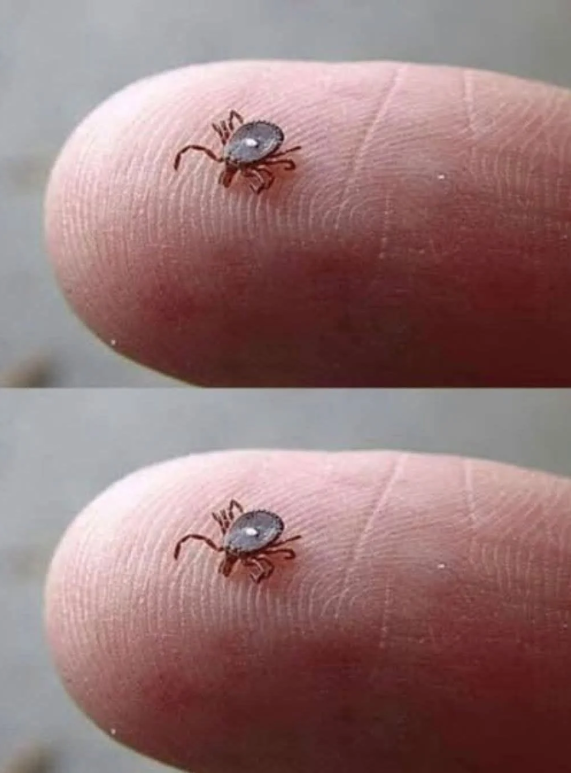
Finding a tick attached to your skin can be unsettling.
They are tiny, easy to overlook, and some can transmit diseases. But the most important thing is not to panic. If you find an attached tick, removing it promptly is one of the best things you can do. The CDC recommends removing it as soon as possible rather than waiting for a medical appointment.
The photo above shows just how small a tick can look next to a fingertip. That is one reason people sometimes don’t notice them until they’ve already attached.
The good news is that you don’t need complicated equipment to remove one.
A clean pair of fine-tipped tweezers is usually enough.


First, Don’t Panic
Seeing a tick on your body does not automatically mean you have contracted a disease.
Ticks can carry different germs, and the diseases they can transmit vary depending on the type of tick and where you were bitten. Lyme disease, for example, is spread in the United States by infected blacklegged ticks, while other ticks can transmit other illnesses.
The first priority is simple:
Get the tick off your skin.
Don’t spend a long time trying to identify it before removing it.
The CDC specifically advises people not to delay tick removal while waiting to see a healthcare provider.
The Best Way to Remove a Tick
You don’t need to burn it, suffocate it, or cover it with a household substance.
Instead, get a pair of clean, fine-tipped tweezers.
Then:
1. Get as close to the skin as possible
Place the tweezers around the tick as close to your skin’s surface as you can.
Try to grab the tick near its mouthparts rather than squeezing its swollen body.
This is important because squeezing the body can make removal more difficult.
2. Pull straight upward
Once you have a firm grip, pull upward with steady, even pressure.
Don’t jerk.
Don’t twist.
Don’t yank suddenly.
The CDC recommends a slow, steady pull because twisting or jerking can cause the tick’s mouthparts to break off and remain in the skin.


What If Part of the Tick Stays Behind?
This is one of the things people worry about most.
Sometimes the mouthparts can remain in the skin after the tick itself has been removed.
If you can easily remove the remaining mouthparts with tweezers, you can do so.
But if they are difficult to remove, the CDC says you can leave them alone. Your skin will naturally push them out as it heals.
The important thing is not to dig aggressively into your skin trying to find every tiny piece.
What You Should NOT Put on the Tick
There are plenty of old-fashioned tick-removal tricks online.
You may hear suggestions involving:
- Petroleum jelly
- Nail polish
- Heat
- Other substances intended to make the tick detach
Don’t use them.
The CDC specifically advises against these methods because irritating the tick may cause it to release infected material into the skin.
The simplest method is still the best:
Tweezers, a steady pull, and proper cleaning afterward.
What Should You Do With the Tick?
Once you’ve removed it, don’t crush it between your fingers.
The CDC recommends several ways to dispose of a live tick, including placing it in a sealed container, wrapping it tightly in tape, flushing it down the toilet, or putting it in alcohol.
Some people choose to keep the tick temporarily in a sealed container in case they later need help identifying what type it was.
However, the CDC generally does not recommend relying on commercial tick testing to decide whether you need treatment. A positive test on the tick doesn’t necessarily mean you became infected, while a negative result can provide false reassurance.
Clean the Area Afterward
Once the tick is gone, thoroughly clean the bite area.
You can use:
- Soap and water
- Rubbing alcohol
- Hand sanitizer
Also wash your hands after handling the tick.
Then take another look at your body.
Why?
Because finding one tick means there could be another.
Ticks can be extremely small and can hide in places that are easy to overlook.


Check Yourself for More Ticks
After spending time outdoors, especially around tall grass, brush, wooded areas, or leaf litter, check your entire body.
Pay attention to areas that are easy to miss.
Look around:
- The scalp and hairline
- Behind the ears
- Around the neck
- Under the arms
- Around the waist
- Around the groin
- Behind the knees
- Between the legs
- Around the ankles
Also check clothing and outdoor gear.
EPA recommends checking the entire body for ticks and removing attached ticks promptly.
What Symptoms Should You Watch For?
Removing a tick doesn’t mean you should spend the next few days assuming something is wrong.
Instead, simply pay attention to how you feel.
Tickborne illnesses can cause symptoms such as:
- Fever or chills
- Headache
- Fatigue
- Muscle aches
- Joint pain
- Rash
The exact symptoms depend on the disease involved.
If you develop a fever, rash, or other concerning symptoms during the days or weeks following a tick bite, contact a healthcare professional.
Tell them that you recently had a tick bite and explain when and where it happened.


Don’t Assume Every Rash Looks Like a Bull’s-Eye
One common image associated with Lyme disease is the classic circular “bull’s-eye” rash.
But that’s not the only possible appearance.
The CDC notes that Lyme disease rashes can have different patterns. Some expand without a clear central ring, while others can have a darker or bluish center.
So don’t dismiss a concerning rash simply because it doesn’t look exactly like the picture you’ve seen online.
If you develop a new or expanding rash after a tick bite, tell your healthcare provider about the exposure.
Could You Need Antibiotics?
Not everyone who gets bitten by a tick needs antibiotics.
In certain circumstances, however, a healthcare provider may recommend preventive treatment after a tick bite, particularly when the situation meets specific criteria for Lyme disease risk.
The CDC says that a single dose of doxycycline may lower the risk of Lyme disease after certain high-risk tick bites in areas where Lyme disease is common. Whether it is appropriate depends on factors such as the type of tick, how long it was attached, and where the bite occurred.
That’s why it’s better not to take leftover antibiotics or start treatment on your own.
If you’re concerned about a recent bite, contact a healthcare professional and give them the details.
Prevention Starts Before You Find a Tick
Of course, the best tick bite is the one that never happens.
If you’re heading into areas where ticks are common, a few simple habits can reduce your exposure.
EPA recommends wearing clothing that covers exposed skin, including long sleeves and long pants, and tucking pants into socks or boots when appropriate. Light-colored clothing can also make ticks easier to spot.
You can also reduce exposure by staying toward the center of trails rather than brushing against vegetation.


Use Repellent Correctly
EPA-registered insect repellents can also help reduce tick bites.
If you’re using a repellent, follow the product label carefully.
Don’t assume that using more will provide better protection.
EPA recommends applying repellents according to their label instructions and avoiding application to cuts, wounds, irritated skin, eyes, or mouth.
DEET is one example of an EPA-registered repellent ingredient that can repel ticks. Protection time varies according to the product and concentration, so the label matters.
Don’t Forget Your Yard
Ticks don’t only belong to deep forests.
Your own yard can provide opportunities for exposure, particularly if there are areas of tall grass, brush, or leaf litter.
The CDC recommends keeping grass mowed, clearing leaf litter and tall brush, and creating separation between lawns and wooded or brushy areas.
If you have pets that spend time outdoors, check them regularly as well. Dogs can bring ticks into the home, and the CDC recommends talking with a veterinarian about appropriate tick-prevention products for dogs. Cats are particularly sensitive to some chemicals, so tick products should not be used on cats without veterinary guidance.
One Small Tick Can Be Easy to Miss
That’s perhaps the most important lesson from the photo above.
A tick can be remarkably small.
You might notice something dark on your skin and assume it’s a speck of dirt.
You might brush it away without realizing it is attached.
Or you may not notice it until after you’ve been outside for hours.
That’s why checking yourself after outdoor activities is such a useful habit.
The CDC emphasizes that prompt removal lowers the opportunity for a tick to transmit disease.
What to Remember If You Find One Tonight
If you discover an attached tick, don’t panic and don’t waste time trying a complicated home remedy.
Remember these steps:
1. Remove it as soon as possible.
2. Use clean, fine-tipped tweezers.
3. Grab it close to the skin.
4. Pull upward slowly and steadily.
5. Don’t twist, jerk, burn, or cover it with petroleum jelly or nail polish.
6. Clean the bite and your hands afterward.
7. Check your body for additional ticks.
8. Watch for fever, rash, or other symptoms in the following days and weeks.
9. Tell a healthcare professional about the bite if symptoms develop or if you’re concerned about your exposure.
A tiny tick can cause a lot of worry, but knowing what to do immediately can make the situation much easier to handle.
The most important thing is simple:
Don’t wait. Remove an attached tick promptly, clean the area, and pay attention to your health afterward.
For Complete Cooking STEPS Please Head On Over To Next Page Or Open button (>)

Britney Spears: The Pop Legend Whose Music Defined a Generation
READ MORE »
Police Are Urging Everyone to Stay Away From This Area as a Major Emergency Unfolds
READ MORE »
An Elderly Woman Checked Into a Motel With a Secret. Then Three Men Arrived
READ MORE »
Pat Sajak with tears in her eyes make the sad announcement See more
READ MORE »
Urgent 3 Extremely dangerous storm just rolled over in B See more
READ MORE »